
What Freya India Gets Right—and Wrong—About Girls’ Mental Health
The Digital Age’s Impact on Girls’ Mental Health
By Dr. Elizabeth Carr, Founder, Kentlands Psychotherapy
Freya India, pop culture influencer, has quickly become one of the most compelling and insightful cultural critics writing about the mental health crisis among young women and girls. Her voice is urgent, passionate, and clearly attuned to the social and emotional lives of girls growing up in our digital age. She sees what so many others fail to emphasize: that today’s teens, particularly girls, are not simply “fragile” or “overly sensitive,” but are navigating a world that is profoundly destabilizing.
Where We Agree
Where Freya excels is in naming the forces that have shifted for girls over the last few decades: the rise of social media and algorithmic comparison culture, the decimation of the typical structures of adolescent communities and face-to-face friendships, the breakdown of family rituals of connection, and the commodification of mental health itself. She is right to suggest that the focus on the individual in popular “therapy culture,” corporate financial agendas dressed up as “empowerment feminism,” and the marketplace have all colluded, intentionally or not, to shape a generation that is both overexposed and underprotected.
Where We Deviate
As a psychologist, I find that Freya’s conclusions sometimes stray from the intended course, not because they are entirely incorrect, but because they stop just short of the deeper clinical truth. She is correct to challenge the popular pathologizing of ordinary emotional distress, especially in adolescence. What she gets wrong is the depiction that we are over-pathologizing “ordinary human or developmentally normal emotional distress. This is because the level of distress that this cohort of young people is experiencing is anything but ordinary. This is not “normal” suffering misunderstood as illness. It is a pervasive, chronic, and environmentally induced injury that is manifesting as legitimate psychiatric illness. It isn’t that we are overdiagnosing. Instead, it is that our young people, especially girls, are living in a world that creates diagnosable mental health disorders at alarming rates.
 The Research
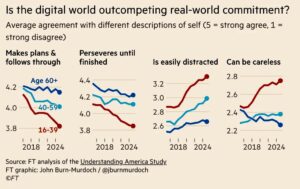
Recent longitudinal data reinforce this point. An analysis of the Understanding America Study by the Financial Times reveals that, between 2018 and 2024, younger adults (ages 16–39) reported significant declines in their ability to make plans, follow through, and persevere until tasks are completed. Over the same period, they showed sharp increases in self-reported distraction and carelessness. These aren’t small fluctuations; they represent a measurable erosion of executive functioning skills within a single generation, and the changes are far more pronounced in younger cohorts than in those over 40. While some may attribute this to personality or motivation, such consistent, population-level shifts point instead to environmental and cultural conditions that are actively undermining focus, persistence, and attention to detail. In other words, we are witnessing in real-time how a destabilizing digital and social environment can harm the very abilities young people need to thrive.
Diagnoses Describe the Symptoms, Not the Cause
Claiming overdiagnosis suggests the diagnostic system is flawed. But what if instead it’s the culture that’s broken? The current Diagnostic and Statistical Manual (DSM) simply assigns diagnostic labels to patterns of symptoms when they reach a certain level of impairment and distress. It gives us standardized criteria and language to ensure consistent discussion of the same phenomena. Because of this system, we can recognize—both in research and clinical settings—that more young people than ever before meet criteria for anxiety, depression, or eating disorders. This increase is not solely due to destigmatization or inherent biological factors, but is primarily shaped by environmental factors. We don’t need fewer diagnoses; we need fewer causes!
Here’s where a clinical background matters. Mental health clinicians, especially psychiatrists, are not under the illusion that Prozac fixes an intrinsic “chemical imbalance.” We know the serotonin theory of depression was always an oversimplification. We also know that medications can help not because they correct a singular biological deficit, but because they interrupt cycles of despair long enough to allow for healing, especially when used alongside therapy, support, and environmental change. Dismissing diagnoses or treatment as if they’re indulgences of a coddled generation misses both the reality of this suffering and the limited tools we currently have to relieve it.
Freya’s critique is important, especially when she highlights the profit motives of platforms and industries that exploit girls’ insecurities. But the challenge for mental health professionals is that, even when we understand the root causes of someone’s distress, we still must treat their symptoms in the here and now. We cannot undo Instagram, bring back nightly family dinners, or reweave a fragmented culture, but we can offer relief from debilitating distress. And often, that relief does come through diagnosis, medication, and therapy, even when we know these tools don’t change the world around our patients.
What Next?
I agree we need to question the narratives sold to girls about what it means to be empowered, connected, safe, and well. We need to resist the temptation to make every painful feeling a medical condition. However, we cannot pretend that suffering is just a matter of perception or groupthink. The world has changed, dramatically. And young women are suffering not because they are overreacting to reality, but because, too often, they are reacting to it in a tragically human and predictable way.
If you have a loved one who is struggling to thrive in today’s world. Talk with them about steps they can take to change their environment, and if one of those changes, at least temporarily, includes mental health support, high-quality practices like Kentlands Psychotherapy are here to offer that support. Call us to learn more at (240) 252-3349, Etx. 807.

It's not an easy time to be a kid. Perhaps it never is, but now it's especially true. Let us help you understand and support your child's needs.

Is your teen struggling with school, in their relationships with friends, with you? Do they seem irritable, withdrawn, unmotivated, sad? Our therapist know how to help.

Are you looking to make some aspect of your otherwise good relationship better? Maybe you’ve tried all the strategies that make sense to you.