
Aunt Lydia’s Moral Reckoning
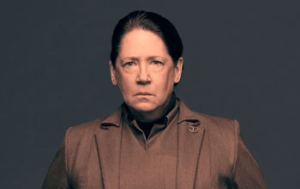
Can People Like Aunt Lydia Change?
What Her Partial Awakening Tells Us About Selective Empathy and Its Path Toward Redemption
As The Handmaid’s Tale draws to a close, few character arcs are as surprising, or as psychologically rich, as Aunt Lydia’s. What began as a portrait of righteous cruelty becomes a study in conflicted loyalty, inner reckoning, and a form of redemption that looks a lot like moral repair.
For viewers trained in mental health, Lydia’s arc is a rare fictional exploration of moral injury, a term often used to describe the emotional and spiritual distress that arises when one’s actions, or inactions, violate deeply held moral beliefs. Though usually discussed in military and healthcare contexts, Lydia’s journey gives the term a new resonance: she’s not a victim of war or burnout; she’s a believer who begins to question the very system she has helped to enforce.
 From Righteousness to Rupture
At the series’ start, Aunt Lydia’s character is unyielding. She wields punishment with a pious sense of purpose, convinced she is preserving humanity by preparing the handmaids for their “sacred role” in Gilead. Her cruelty isn’t random—it’s sanctified. And for several seasons, we see no sign of doubt.
But doubt does creep in, if ever so slowly, through her repeated exposure to the consequences of her actions. We see it in her attachment to Janine, in her horror at the mistreatment of the Handmaids at the Magdalene Colonies, and in the mass murder of the girls at Jezebels. Eventually, we also see it in her increasing disillusionment with the men she once defended as godly leaders.
Lydia begins to see how the rules she enforced didn’t uphold holiness; they simply justified brutality as devotion.
The Anatomy of Moral Injury
It’s important to understand that moral injury is about conscience. It emerges when someone realizes they’ve betrayed their values or been part of a system that forced them to act against what they believe is right.
- Shame and disillusionment: Her once unshakable faith in Gilead’s moral structure falters.
- Protective over-identification: She clings to her role as “protector” of the Handmaids, especially Janine, even as she participates and remains complicit in their torture and oppression.
 Emotional isolation: Her growing awareness alienates her from both her superiors and her peers, who largely remain loyal to Gilead’s orthodoxy. The exception is Commander Lawrence, who, in this final season, seems to recognize the cracks developing in Lydia’s defense mechanisms and is all too willing to facilitate their deepening by offering no reassurance or solace in her growing uncertainty.
By the end, Lydia is a woman divided between her ideology, which once provided her life with meaning, and her conscience, which must be given voice.
Attempts at Moral Repair
Moral injury isn’t just about what’s broken; it’s about what comes after. In therapy, we frame moral repair as the ongoing, often painful work of trying to realign with one’s values after a rupture.
Aunt Lydia’s efforts at moral repair begin in several powerful ways:
- She defies the men of Gilead. In one of the final episodes, Lydia publicly refers to them as “godless men,” signaling a seismic shift in allegiance. This isn’t rebellion for its own sake; it’s a declaration of conscience.
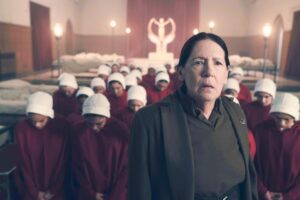 She gives the Handmaids a choice. In a climactic moment, she allows June and the others to take justice into their own hands by stepping back and releasing them to their own devices. This act is powerful. Lydia, who once enforced every rule with rigid authority, chooses to let go, not necessarily from her beliefs but from her need to control others through them.
- She nurtures instead of punishes. Her relationship with Janine increasingly becomes one of care, ineffective protection, and heartbreak. However, rather than this shift signaling a full moral reckoning, it reflects a more limited awakening. Although Lydia is beginning to care about one individual’s suffering, she has yet to grasp the structural violence of the system she serves. Her protectiveness over Janine seems more rooted in personal attachment than in moral clarity. This type of proximity-based empathy emerges when one’s moral stance begins to soften, but only after the issue personally affects them. In these circumstances, it’s often less about awareness of systemic oppression and more about a rupture in the relationship that sparks the shift.
Cracks in the Armor
This pattern is common in the early stages of moral development and the repair of moral injury. People often start by recognizing harm in narrow, relational contexts before they can bear the cognitive and emotional weight of confronting the broader system. Lydia can see the cruelty when it affects someone she loves, but perhaps cognitive dissonance prevents her from acknowledging how it has impacted everyone.
And yet, we witness pivotal cracks in her allegiance. In one of the final episodes, Lydia publicly refers to the Commanders as “godless men.” This moment demonstrates a significant change in her worldview. Not only is she questioning their authority, but she may also be challenging the moral foundation that justified it. Still, her language reflects personal betrayal more than ideological rejection. Her rage is real, but it isn’t fully integrated. Does she simply see these men as flawed actors in a justifiable, God-ordained system?
Even her most dramatic gesture, allowing the Handmaids to exact revenge, feels emotionally driven more than ethically reasoned. She steps aside, yes, but she does not take ownership. She creates space for others to act, yet there is equivocal evidence that she holds herself accountable for how they came to be in that position.
A Partial Reckoning
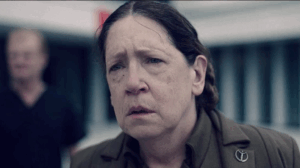 Lydia’s arc doesn’t offer us the satisfaction of full atonement or redemption. Instead, it illustrates something more psychologically realistic: moral development as a layered, nonlinear process. She moves from certainty to discomfort, from righteous cruelty to personal care and doubt. She has yet to complete her journey to systemic awareness or self-confrontation.
In this way, she remains a tragic figure—someone capable of immense loyalty and love but unable (so far) to hold the full mirror up to herself. Her moral injury is not yet fully metabolized, and the harm she enabled is not yet deeply understood. And in that regard, she may still be in for a world of hurt one day.
For those of us in mental health or moral philosophy, Aunt Lydia’s story reminds us that even partial reckonings matter. Change often begins not with sweeping ideological reversals but with personal contradictions, like realizing the harm when it touches someone we love. It’s the same pattern we see when long-held beliefs shift only after a son comes out, a hard-working neighbor is deported, a spouse loses their job, or a daughter is maimed under a healthcare ban once supported.
These moments may not represent full awareness, but they are opportunities. They often mark how individuals begin to shift from unquestioning loyalty to conflicted humanity. In that shift, while incomplete, there exists both danger—when personal empathy serves as a substitute for structural change—and hope, that deeply indoctrinated individuals are capable of growth, empathy, and transformation.
If you’ve experienced a moral injury and feel you could benefit from some support, consider talking with a trained mental health provider. And if you are in the Gaithersburg, MD area, call us. We would be honored to support you in your healing process.

It's not an easy time to be a kid. Perhaps it never is, but now it's especially true. Let us help you understand and support your child's needs.

Is your teen struggling with school, in their relationships with friends, with you? Do they seem irritable, withdrawn, unmotivated, sad? Our therapist know how to help.

Are you looking to make some aspect of your otherwise good relationship better? Maybe you’ve tried all the strategies that make sense to you.